


September
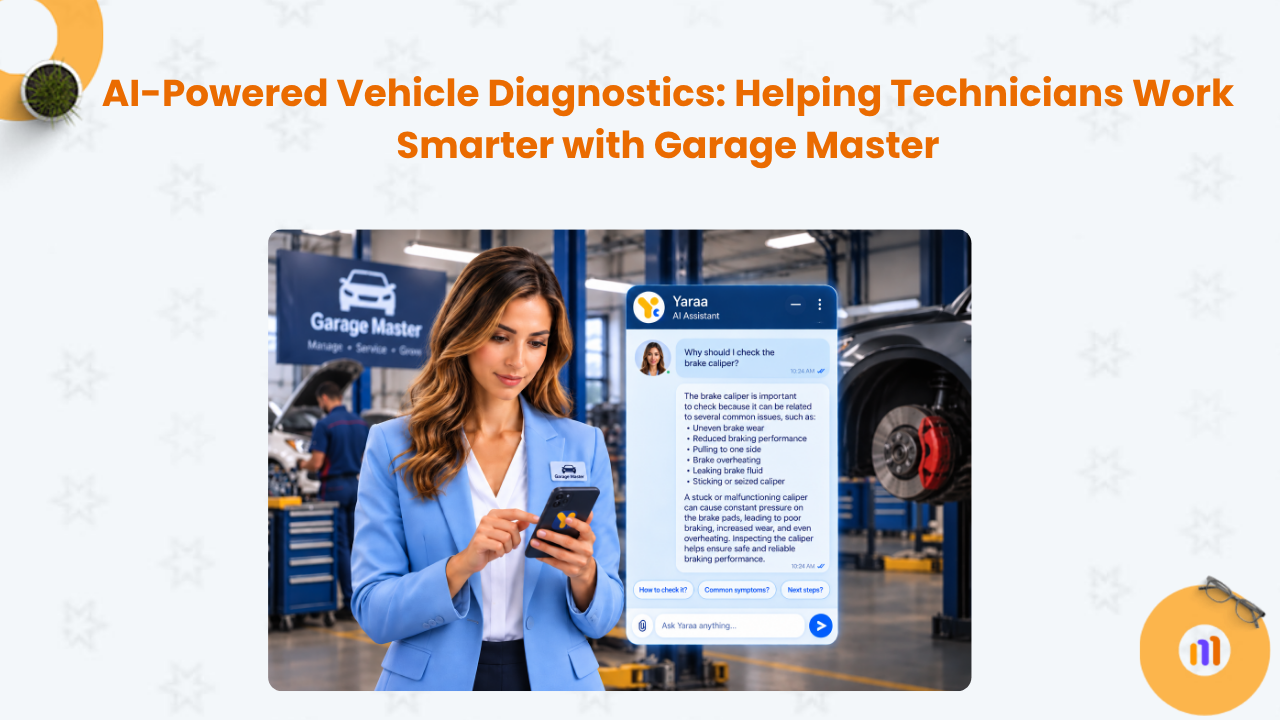
AI-Powered Vehicle Diagnostics: Helping Technicians Work Smarter with Garage Master
Managing an automotive workshop involves much more than repairing vehicles. Every repair job requires accurate customer information, vehicle details, inspections, job cards, spare parts, quotations, invoices, payments, and service history.
Garage Master brings these essential workshop activities together in one centralized garage management system. It helps garage owners, service advisors, technicians, and staff organize their daily operations while keeping the complete vehicle repair workflow in one place.
As workshops handle more vehicles and repair jobs, technicians also need faster and simpler ways to understand customer complaints, identify relevant components, and determine what should be checked next.
This is where AI-powered assistance can add another layer of support to the diagnostic process.
AI Assistance for Automotive Technicians
An AI assistant can support technicians by helping them understand vehicle problems, explore relevant diagnostic checks, and learn while they work.
Instead of searching through multiple sources every time they encounter an unfamiliar problem, technicians can describe the issue in natural language and ask follow-up questions.
Here are some ways AI assistance can support technicians in the workshop.
1. Understand the Vehicle Problem
Technicians can describe a vehicle problem using simple language and provide useful information such as mileage.
For example:
Problem: Brake making a strange noise
Mileage: 65,000 km
Based on the information provided, AI can help the technician identify relevant areas that may need inspection.
This gives the technician a useful starting point for the diagnostic process.
2. Get Guidance on What to Check
A technician can ask:
“What should I check first?”
Based on the symptoms and information provided, the AI can suggest relevant areas to consider, such as:
- Brake pads
- Brake discs
- Brake caliper
- Brake fluid and related components
- ABS system when an ABS warning is present
The technician can then perform the appropriate physical inspections and diagnostic tests.
3. Add Inspection Results and Continue
Vehicle diagnostics are often a step-by-step process. What a technician discovers during one inspection can influence what should be checked next.
For example:
Technician:
“The brake pads are good.”
The technician can then ask:
“What should I check next?”
The AI can use the updated information to provide further suggestions for areas that may be relevant to the reported symptoms. This makes the diagnostic process more interactive and adaptable.
4. Get the Next Diagnostic Suggestion
Suppose the technician has already checked the brake pads and found no issue.
They can ask:
“The brake pads are good. What should I check next?”
The AI can help identify other potentially relevant components or diagnostic areas, such as the brake discs, caliper, or other systems depending on the symptoms.
The objective is to help technicians work through the diagnostic process systematically rather than immediately deciding to replace a component.
5. Get Help With Sensor-Related Problems
Sensor-related issues can sometimes require several checks before deciding whether replacement is necessary.
A technician might ask:
“Do I need to replace the sensor?
Instead of treating replacement as the first step, AI can help the technician consider relevant diagnostic information, including:
- Fault codes
- Sensor condition
- Electrical connectors
- Wiring
- Sensor signal
- Diagnostic test results
This can help technicians understand what should be checked before deciding whether a component needs replacement.
6. Understand Why Something Needs to Be Checked
AI assistance isn’t only about suggesting what to check. Technicians can also ask why a particular component or system should be inspected.
For example:
“Why should I check the brake caliper?”
The AI can explain the possible relationship between the reported symptom, the component, and the diagnostic check.
This can be particularly useful for technicians who want to understand the reasoning behind a diagnostic step rather than simply following a checklist.
7. Learn While Working
AI can also become a useful learning assistant for technicians who are developing their diagnostic skills.
They can ask questions such as:
- “What should I check first?”
- “Why should I check this?”
- “What should I check next?”
- “What could cause this problem?”
- “Do I need a diagnostic test?”
- “What information should I collect?”
This allows technicians to use real workshop situations as opportunities to learn and improve their diagnostic knowledge.
8. Reduce Unnecessary Searching
Technicians often encounter unfamiliar symptoms, components, or diagnostic situations.
Finding the right information can take time, especially when information is spread across different sources.
With an AI assistant, technicians can describe a problem in their own words and ask questions conversationally.
This can help them explore relevant information more efficiently and spend more time focused on the vehicle.
9. Support New and Experienced Technicians
AI assistance can be useful for technicians at different experience levels.
For experienced technicians, it can provide an additional source of information when they encounter an unfamiliar issue.
For new technicians, it can provide guidance on possible diagnostic steps and explain why certain checks may be relevant
However, AI should be treated as a support tool—not a replacement for professional training, diagnostic equipment, technician expertise, or judgment.
The technician remains responsible for inspecting the vehicle and making the final repair decision.
10. Help Technicians Work Smarter
The goal of AI assistance is simple: make diagnostic work easier to understand and more efficient.
Technicians can use AI to help:
- Understand customer-reported vehicle problems
- Identify relevant areas for inspection
- Explore possible causes
- Determine what information may be useful
- Ask follow-up diagnostic questions
- Understand why a particular check may be relevant
- Learn from real workshop situations
- Work through diagnostic possibilities step by step
Garage Master + AI-Powered Assistance
Garage Master provides the garage management platform that helps manage the operational side of an automotive workshop from customers and vehicles to job cards, parts, quotations, invoices, payments, and service history.
AI-powered assistance can complement this workflow by providing intelligent support during the diagnostic process. Garage Master can integrate with Yaraa AI to provide this type of conversational assistance to technicians.
Together, garage management and AI assistance can create a more connected workflow where workshop teams can manage their business while technicians have an additional tool to help them understand vehicle problems and explore relevant diagnostic checks.
The Future of Smarter Garage Management
AI is changing how businesses access information and support everyday decisions, and automotive workshops are no exception.
For garages, the opportunity isn’t about replacing skilled technicians. It’s about giving technicians better tools to support their knowledge and experience.
An AI assistant can help technicians ask questions, understand symptoms, explore possible causes, and identify relevant checks through a simple conversational experience.
With Garage Master, workshops can bring their core management processes together while preparing for a smarter, AI-assisted approach to vehicle diagnostics.
Manage your garage smarter. Support your technicians better.